


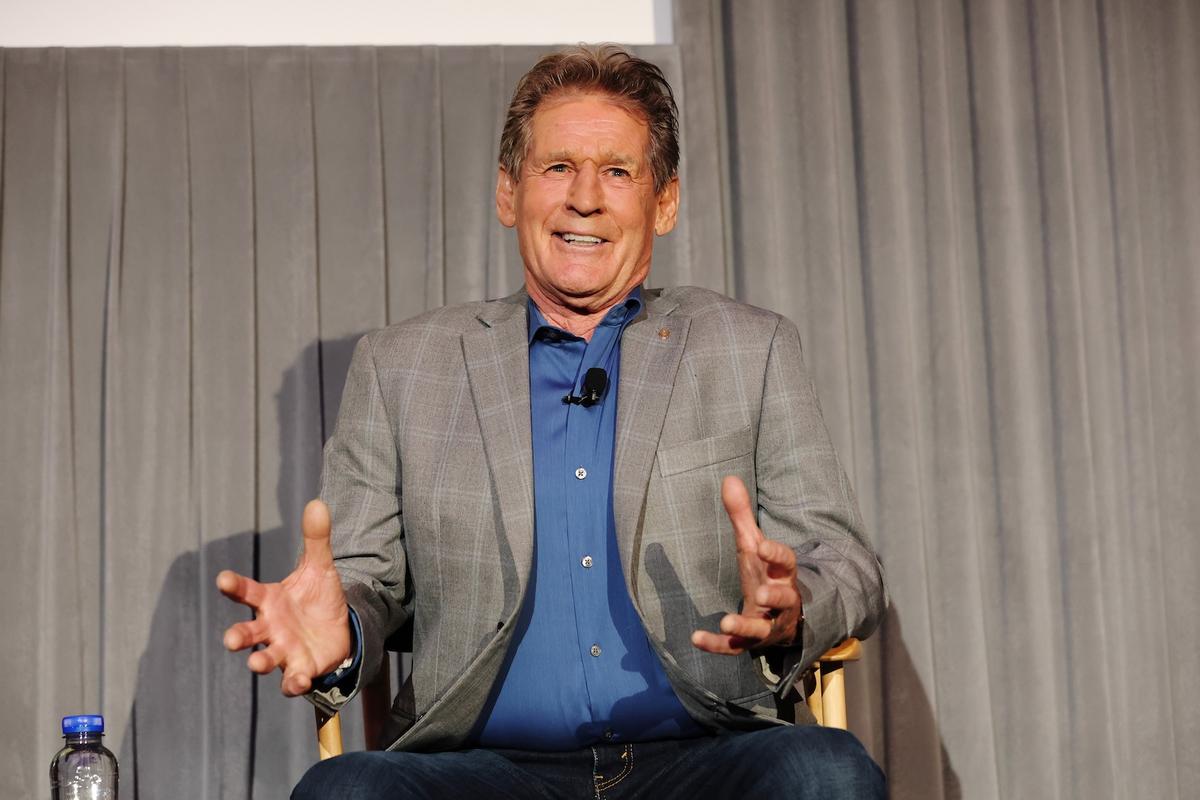
Buddy Joe Hooker has been a stuntman for a long time. And if you aren’t certain exactly how long, he will tell you.
“I’m a second generation stuntman. My father (Hugh Hooker) was a very well-respected western stuntman and coordinator,” Hooker told me after I mentioned that he’d a career in stunts spanning more than six decades. He quickly corrected me: “I did my first stunt on a black-and-white TV series called (The Adventures of) Rin Tin Tin when I was 13. I’ve been doing this a tad over 70 years.”
In other words: There may not be a person on Earth more qualified than Hooker to co-curate and provide historical context to the Criterion Channel’s new collection of movies celebrating the art of stunt design. In addition to a selection of titles spanning the history of action cinema from Safety Last! to Death Proof — which Hooker worked on as a stunt driver — Criterion also recorded an interview with Hooker called “Spotlight on Stunts!” where the longtime actor and stunt performer offers his perspective on the craft.
And when Criterion offered me the chance to talk to Hooker myself, I couldn’t resist. In the conversation that follows, we discuss why he thinks the famous chase scene in Bullitt doesn’t quite hold up to modern standards, the difference between comedic and dramatic stunts, and his decades-long crusade to convince the Academy of Motion Picture Arts and Sciences to create an Oscar for stunts.
I watched the “Spotlight on Stunts!” that you did for the Criterion Channel. One thing that surprised me was when Bullitt came up, you said “When I look at it now, I go, ‘Eh!’” I thought that was interesting. Why does that car chase remain one of the ones that people still cite when they talk about the best in movie history?
Well, I think there’s a number of reasons. One of them being Steve McQueen was the actor. It was highly touted at the time that Steve McQueen did his own driving. And he actually did do a lot of his own driving. But he also had a stunt guy that did most of the jumps and all that kind of stuff.
The other thing is that it was the first car chase in a big major film. So that’s one of the things that I think has kept it up there as a famous car chase. But when I look at it now, I just go “Wow, compared to what we did when we tried to outdo it on a film called Jade with Billy Friedkin, it was, like, a night and day difference.”
But I have to give it credit. (Bullitt) was the first one. It was like Evel Knievel. He didn’t have a great completion record, and he wasn’t the greatest motorcycle guy, But he was the first one. So you gotta give him credit for that.
When people make those lists of the best car chases, there are some that always get included: The French Connection, To Live and Die in L.A. — which you worked on and is still incredible — Ronin. Is there one that in your mind doesn’t get enough attention but deserves to be included in that kind of Hall of Fame of car chases?
Just to be a little off the wall here, there’s some car chases back in the silent era that still blow my mind. Everything they did back then was totally for real. And when you look at some of the stunts they did, it’s mind-boggling. I can’t recall the exact names, but anybody that’s interested in looking at some of the great car chases, they should look at the silent era.
Another one that comes to mind, is the original Gone in 60 Seconds. It really is amazing that that film got done, because it was all off the cuff. They had no permits, they had no anything. They just went out on the city streets and did this stuff, which was rather amazing to me that they pulled it off. And it was one of the forerunners to crash a lot of cars. The guy (Gone in 60 Seconds director/star/stunt driver H.B. Halicki) owned a junkyard. (laughs) So it was a very interesting tale.
READ MORE: How John Wick: Chapter 4’s Creators Crafted the Incredible Stairwell Sequence
When we were talking about Bullitt, you mentioned that one of the reasons it went down in legend is because Steve McQueen was a good driver, and did some of his own driving, and that became part of the way the film was promoted. And to this day, that’s how almost every action movie is marketed. “This actor did all of his own stunts! He did everything!”
They don’t always say it; they allude to it. And there are still some actors that will say point blank with a straight face that they did all their own stunts, when anybody that has any sense knows they don’t.
We have a sophisticated viewing audience now, and people don’t believe for an instant that these people are doing their stuff. They understand that it’s a $100 million dollar project, and you can’t afford to put your lead actor out there to let him do this — unless you’re Tom Cruise, and he puts that in his contract that if he doesn’t get to do his own stunts then he won’t do the film.
But when Tom Cruise does one of these stunts, he has already had four to six of his stunt doubles perfect it. They research it, they rehearse it, they do everything before Tom Cruise gets on the side of that plane. So I’ve gotta give Tom Cruise credit for wanting to do that stuff, but, again, we have to keep in mind how he got to do that because he had stuntmen, these invisible guys make it happen for him.
Does it bother you when an actor claims they did all their own stunts? Or is that just part of being a stuntman? You used the word “invisible,” and that is what is expected, I suppose.
It doesn’t bug me too much. As stuntmen, we all chose this. Nobody dragged us to work every day. We went there voluntarily because we loved what we were doing. We didn’t care if anybody thought it was the actor or us or whatever. We knew what we did when we left the set. And pretty much it never bothered me ever that somebody thought that somebody else did it instead of myself. The people that really cared in my life and in my profession knew who did it.
Going back to Steve McQueen: I knew Steve very well. I raced motorcycles with him forever. We had a great relationship, with cars and all that kind of stuff. Steve was the real deal. He could drive, and he did do some great driving (onscreen), but only up to the point where it might get too dangerous and they might lose their actor. Then the producer steps in and says “No.” And I’m sure he did argue at length with him about it, that he wanted to do it. (laughs)
Right. Some people hear the word “stunts” and they think that only means action movies. But you have worked on every possible genre, including a bunch of classic comedies like Blazing Saddles and Superbad. I’m just curious: Is doing a stunt in a comedy any different than doing stunts on a drama or an action movie?
Looking back at the silent film era again, most of the actors were stuntmen too. And most of their early films were comedy-based. They wanted to make the audience laugh. So they did these pratfalls and they did all these stunts that were physically very damaging, I would imagine, to whoever was doing it. But it was all to make the audience laugh.
When I would do a film as a coordinator or a stunt person, I always found that doing comedy stunts were way harder than regular stunts, both physically and whatever outcome you wanted to achieve on film. If you drive a car and do a cannon roll and there’s multiple explosions and blah, blah, blah, it always looks good. When you do a comedic stunt, you really have to go out there to make it look good, to make it, achieve what you wanted it to do on film. So to your question, I always found the comedic ones way tougher.
Huh. That’s interesting.
I’d rather do a hundred foot high fall than some of these kind of pratfalls and stair falls and stupid stuff like those Home Alone things where you’re up in the air and land flat your back. Those things are tough on you.
In 70 years of stunt work, you’ve seen it all. And after all those years working on films, when you’re on a set now can you tell if a movie is going to work or if it’s going to be a hit? Does the final product still surprise you sometimes?
Some films, like To Live and Die in L.A. for instance, you kind of have a feeling that it’s going to turn out good. The car chase, anyway. Because Billy Friedkin had a track record. Before we even did the car chase, he sat me down and had a little face-to-face meeting with me and told me, “Look, if this car chase isn’t any better than the one in The French Connection, I don’t care how much time we spent or how much it costs, it will not be in the f—ing movie.” (laughs) So that told me something right off the bat! I had my work cut out for me. And I knew it was gonna be good because Billy was one of the great editors of chases. He had an eye for that kind of stuff.
There were other ones where … I did a film called The Hunted with, again, Billy Friedkin, and Tommy Lee Jones. And we spent a lot of time on it, and I thought it always was going to be incredible. And the film did turn out really good. But box-office wise, it didn’t do that well. I’m not sure why, if it was how they promoted it or whatever. But you never really can tell.
We’re now a couple years away from finally getting an Academy Award for Best Stunt Design. Why did it take so long for the stunt Oscar to happen?
Let me give you a little bit of backstory on that. First of all, there was, I would say, an “old boy” or “old school” mentality in the Academy for years. They still thought that they didn’t want to give an award for stunts or stunt coordinating or anything to do with stunts because they were afraid that the audience wouldn’t go see the movie if they thought their actor wasn’t doing this stunt.
Really?
That was their original argument when I first started dealing with them with two other stuntmen — Bobby Bass and David Ellis — like in the mid-’80s. That’s when we first started having our discussions with the president and vice president and so forth. They were still of that thinking that “Hey, we don’t want to give it away.” And we’re going, “The audience knows! And if you had clips of the action sequences, I think it would even make your show better.”
They didn’t get it. So for the next 20-something years with different administrations, every time a new president or whatever would come in, we would start it all over again. It was like one step forward, two steps backward. There were always some excuses about why they couldn’t have it.
I see.
It got down to a point of “How do we do it? How would it be voted on?” And there are no stuntmen or stunt coordinators in the Academy. Finally they got tired of us, I think, and inducted the three of us, myself included, as the first stuntmen inducted into the Academy of Motion Pictures Arts and Sciences. So we continued our crusade with them. And they finally said “Well, you need to get more qualified members so you’ll have more of a voting population.” There was a deaf ear to everything that we proposed …
What really worked was there was a point where Arnold Schwarzenegger, who was one of the biggest action actors of that time, came forward and generously applauded his stunt doubles, stunt coordinators, and went on and on about how that if we didn’t have them, we wouldn’t have the kind of action films that we have. And that the Academy is remiss if they do not come up with some kind of a category so that they can be appreciated in the industry along with everybody else in the Academy. So that was a huge deal. He got a lot of other A-list actors on board, and I think that was the turning point.
Well, it’s way overdue.
It’s way, way overdue. It’s been a long battle. I don’t want to badmouth the Academy. I just think there was some people in there that were uninformed or didn’t really know. I went to a meeting once — this’ll blow your mind — I was at an executive meeting, I think, with one of the vice presidents and her executive committee. And we were having a great meeting and she said, “Let me ask you a question, now that we’re getting into this. What do stunt coordinators actually do on a set?”
(laughs)
This is the vice president of the Academy, who doesn’t know what a stunt coordinator does and is in a committee on (stuntmen) getting an award. So anyway, that’s what we were dealing with.
The “Stunts!” collection, including Buddy Joe Hooker’s “Spotlight on Stunts!” feature, is currently available on The Criterion Collection. The Best Stunt Design Academy Award will be given out for the first time at the 100th Academy Awards in 2028.

The Best Action Movie of Every Year of the 1980s
The 1980s were an incredible decade for action movies. Here are the ten best movies for each of its ten years.

